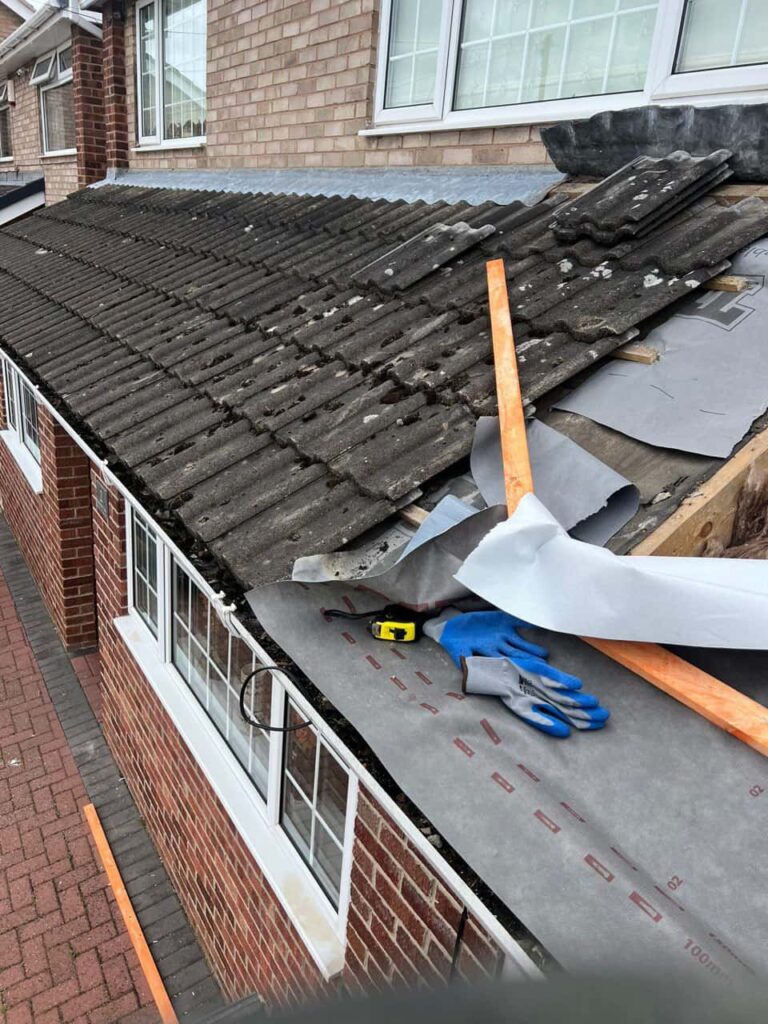
A roof leak that appears during every spell of rain is relatively straightforward to recognise as a roofing problem. More confusing is a leak that only seems to develop when heavy rain is accompanied by strong winds. During ordinary rainfall the roof may appear completely watertight, yet in more exposed conditions water suddenly finds its way inside.
This pattern can provide an important clue. Wind-driven rain approaches a roof differently from rainfall falling mainly downwards, allowing moisture to reach gaps, junctions and weakened details that remain unaffected in calmer conditions.
At LS Roofing Furze Platt, we provide professional roof repairs and leak investigation throughout Furze Platt, Berkshire. Understanding why a leak occurs only under particular weather conditions is an important part of identifying the actual defect and carrying out an effective repair.
Why Does Wind Change How Rain Affects a Roof?
Roofing systems are designed to shed rainwater downwards towards the gutters. Strong winds can change the direction in which rain reaches the building.
Instead of simply landing on the roof covering and flowing down the slope, wind-driven rain can be forced:
- Beneath slightly displaced tiles
- Towards vulnerable roof junctions
- Against flashing
- Under exposed edges
- Around roof penetrations
- Into small gaps that are normally protected
This explains why a roof can remain dry during ordinary rainfall but leak when the weather becomes more severe.
A Slightly Displaced Tile May Be Enough
Tiles do not always need to be completely missing before water ingress occurs.
A tile that has moved only slightly may continue to overlap surrounding materials sufficiently during normal rainfall. When wind pushes rain across or upwards against the roof covering, however, water may reach beneath that weakened overlap.
Signs of tile problems can include:
- Uneven rows
- Slightly lifted tiles
- Cracked corners
- Loose materials
- Roofing debris around the property
Professional inspection can determine whether an apparently minor defect is creating a vulnerable entry point.
Flashing Can Become Vulnerable to Wind-Driven Rain
Flashing protects some of the most complicated and vulnerable parts of a roofing system, particularly where the roof meets another surface or feature.
If flashing has lifted, deteriorated or developed a small gap, ordinary rainfall may still be directed away effectively. Strong winds can force water against the detail from a different angle, exposing the weakness.
Because flashing defects can be relatively small, they are not always obvious from ground level.
Roof Junctions Require Particular Attention
Any location where different roof surfaces or building elements meet requires careful weatherproofing.
These junctions can become vulnerable as materials age or move. During difficult weather, water may be driven towards areas that receive comparatively little direct exposure under normal conditions.
A leak that occurs only during strong winds may therefore require close examination of the surrounding roof details rather than simply the main field of tiles.
Ridge and Hip Areas Can Develop Weaknesses
Ridges and hips are highly exposed parts of a roof.
Over time, materials and fixings around these areas can deteriorate or become less secure. Strong winds may place additional pressure on already weakened components, while driven rain can reach openings that are not normally exposed.
If water ingress appears following particularly windy weather, these higher and more exposed sections may need to be included in the inspection.
The Direction of the Wind Can Provide a Useful Clue
Some homeowners notice that a leak occurs only when the wind comes from a particular direction.
This information can be valuable during a professional investigation.
If one elevation or roof slope is especially vulnerable, rain driven from a certain direction may reach a defect that remains sheltered at other times. Noting the conditions when the leak appears can therefore help narrow down the likely source.
Useful observations include:
- Which room is affected
- Where the dampness first appears
- Whether the leak occurs immediately or after prolonged rain
- Whether wind direction seems relevant
- Whether the problem occurs during rain without wind
These details can support a more focused roof assessment.
Water May Travel Before Becoming Visible Indoors
One of the most important points to understand about roof leaks is that the internal damp patch does not always sit directly beneath the external defect.
Once rainwater passes beneath the roof covering, it may travel along:
- Underlay
- Battens
- Rafters
- Other roof timbers
It can then drip into the property some distance from where it originally entered.
Simply inspecting the roof immediately above the internal stain may therefore fail to identify the true problem.
Ageing Underlay Can Make a Minor Defect More Noticeable
The tiles or slates are the primary weather-resistant covering, but the layers beneath also contribute to the roof’s protection.
Where underlay remains in good condition, it may help manage small amounts of moisture that get beneath the external covering. If it has deteriorated, torn or become damaged, water entering during wind-driven rain may find its way into the roof space more readily.
An effective investigation should therefore consider more than the visible surface materials.
Why the Leak Should Not Be Ignored Between Storms
When a leak disappears as soon as calmer weather returns, it can be tempting to assume the problem has resolved itself.
Unfortunately, the underlying defect will usually remain.
The next period of strong wind and rain may allow further water ingress, potentially affecting:
- Roofing battens
- Structural timbers
- Insulation
- Ceilings
- Internal finishes
Intermittent leaks are still genuine roofing defects and should be investigated before repeated exposure allows damage to spread.
Strong Winds Can Make Existing Defects Worse
Wind does not merely expose weaknesses. It can also contribute to their progression.
A slightly loose roofing component may move further each time it is exposed to difficult conditions. Small openings can become larger, fixings may weaken and surrounding materials can begin to move.
A roof that leaks only occasionally today may therefore become increasingly unreliable if the original defect remains unattended.
Finding the Cause Is More Important Than Treating the Damp Patch
Internal staining shows where water has eventually reached the living space, but repairing the interior alone will not stop the leak.
Effective roof leak repair requires identifying:
- Where the water is entering.
- Why the roofing system is allowing it through.
- Whether surrounding materials have also been affected.
- What repair will restore reliable weather protection.
This is where professional roof inspection provides particular value.
Can a Wind-Driven Leak Be Repaired Locally?
In many cases, yes.
If the problem is caused by a clearly defined defect and the surrounding roofing system remains sound, a targeted repair may be appropriate. This could involve correcting damaged tiles, flashing or another localised roofing detail.
However, if inspection identifies widespread deterioration or several vulnerable areas, a broader repair may be necessary.
The appropriate solution should always be determined by the actual condition of the roof rather than the size of the internal water mark.
Professional Roof Leak Investigation in Furze Platt, Berkshire
Intermittent roof leaks can be particularly frustrating because the roof may appear completely dry when it is inspected casually during settled weather. Understanding the conditions in which the problem occurs is therefore an important part of diagnosis.
At LS Roofing Furze Platt, we provide professional roofing services throughout Furze Platt, Berkshire. We assess the roof covering, vulnerable junctions and surrounding components to identify the likely route of water ingress and determine the repair needed to restore dependable protection.
The objective is not simply to patch the most obvious location but to resolve the underlying roofing defect.
Conclusion
A roof leak that only occurs during strong winds often indicates that wind-driven rain is reaching a weakness that remains protected during ordinary rainfall. Slightly displaced tiles, deteriorated flashing, vulnerable junctions, ageing underlay and exposed ridge or hip details can all contribute to this type of intermittent water ingress.
Because water can travel beneath the roof covering before appearing indoors, accurately identifying the source is essential. Waiting for the next period of severe weather can allow a small defect to worsen and increase the amount of surrounding material affected.
If your roof only leaks during strong winds or particularly difficult weather in Furze Platt, Berkshire, contact LS Roofing Furze Platt. Our experienced team can investigate the source of the water ingress and recommend a focused, appropriate repair to restore reliable protection to your property.
Call us on: 01628 562 691
Click here to find out more about LS Roofing Furze Platt
Click here to complete our contact form and see how we can help with your roofing needs.